
1.1 Why automate a business process? Advantages and Objectives
WHAT ARE THE ADVANTAGES?
The main motivations and benefits can be summarized as follows:
Saving time
By delegating the execution of internal business processes to the system, people are given the opportunity to focus on other activities—sometimes freeing themselves from daily "headaches."
Minimizing costs and errors
Human errors, misunderstandings, and oversights always result in additional costs. Minimizing them is a challenge every company must face.
Optimizing communication
Endless flows of emails and phone calls between departments are not the most efficient way to organize and manage work—especially when completing a process requires the involvement of different teams at different stages.
In an automated process, each person is guided by system notifications that indicate what needs to be done and when. Moreover, all operations, requests, and changes are recorded and traceable, minimizing the risk of lost information.
Reinforcing awareness of roles and responsibilities
For the workflow to be correctly managed through the software, every team member, in every department, must clearly understand their tasks and responsibilities. This requires a clear definition of hierarchies and interdepartmental relationships, and most importantly, a clear indication of who assigns tasks, provides input, and approves or rejects outputs.
Keeping everything under control
Managing workflows in an automated way not only allows you to know the status of each activity at any given time but also to maintain an overview of the entire situation. Automating monitoring means fewer meetings and a significant time saving.
WHAT ARE THE OBJECTIVES OF BPMN?
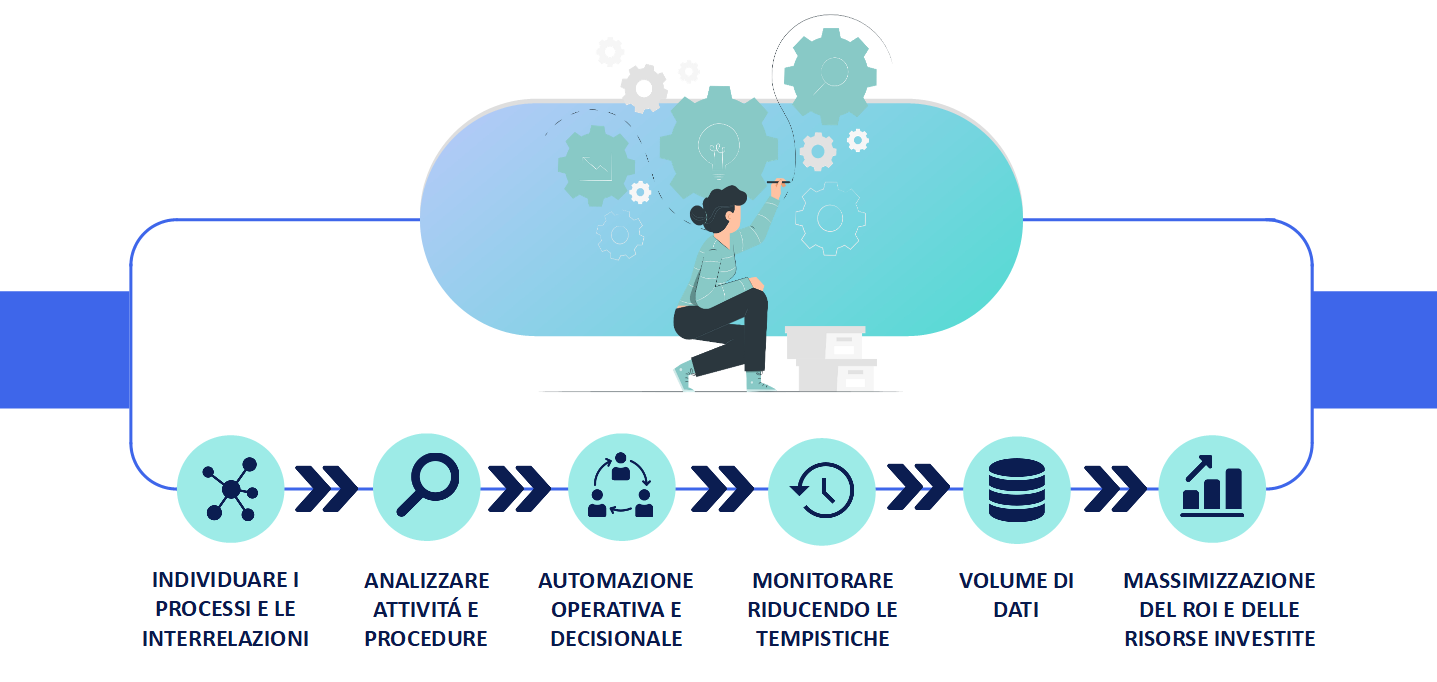
The main objectives can be summarized as follows:
 The ability to identify so-called “bottlenecks,” which often cause damage by reducing overall productivity.
 The ability to monitor the operational flow of business procedures, helping to avoid stumbling over even the most complex scenarios.
 Improving the exchange of information to facilitate data management at a structural level.
 Having a unified “blueprint” of processes so that all business workflows can be executed and managed consistently.
 Effectively integrating people and activities by using tools that are accessible to all types of business roles—not just technical ones.